 Magnolia
Sometimes the answer is new software. Often it isn't.
We start with discovery and a straight recommendation: buy, connect what you already have, or build. When we build, it's in your repo, and it's yours.
Discovery decides everything else.
Discovery
We interview the people who will use it, document how work happens today, and write a requirements document with scope options, a price range, and a build or don't-build recommendation. You own the document either way.
Build
Two-week sprints with a recorded demo at the end of each. You can change priorities every sprint.
Launch
Deployment, training for your team, and documentation for whoever maintains it next.
Stabilize and stay
Thirty days of fixes included, then a retainer sized to how complex the tool is.
Buy it, connect it, or build it?
Answer three questions. You'll see where most projects like yours land.
Where you'd likely land
Pick an answer for each one. Not sure is a fine answer; that's what discovery is for.
Usually costs
Discovery from $2,500, credited toward any buildWhen people outside your team use it, or the process is what sets you apart, owning the software is usually worth it.
Usually costs
Focused builds from $8,500. Discovery comes first.Choose the product that fits, then connect it to the tools you already use so nobody copies data by hand.
That's what Rosie's House did: they chose DreamClass, built for music schools, and we connected it to their Salesforce with a Make.com flow. No custom code.
Usually costs
Software evaluation, plus integrations from $1,500A product built for organizations like yours is usually cheaper and faster than building. We help you choose and set it up.
Usually costs
Software evaluation and setup, scoped on the first callThe tools may be fine. The problem is the gaps between them. Integrations close those gaps.
Usually costs
Integrations from $1,500Not enough is clear yet. One to three weeks of discovery ends with a written recommendation: build, buy, or neither.
Usually costs
Discovery from $2,500, credited toward any build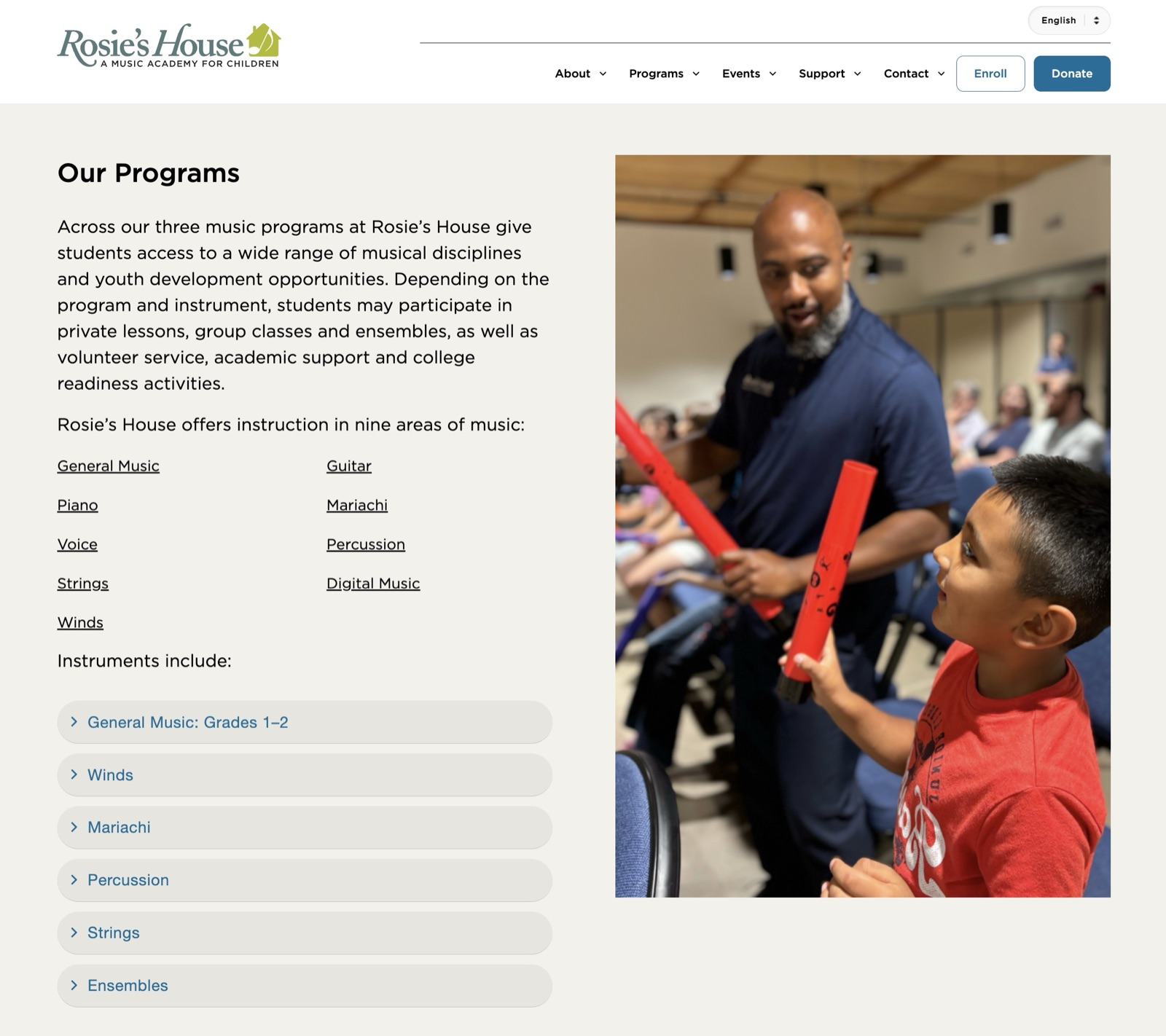
I can't express enough how grateful I am for everything that you have poured into this project. You set us up well for success. Thank you! Thank you! Thank you!

What you own at the end.
- 01
The requirements document
Yours whether or not you build with us.
- 02
Source code in your repository
Ruby on Rails with Hotwire, React where it earns its place, PostgreSQL.
- 03
Hosting in your account
Heroku, Render, AWS, or your existing stack.
- 04
Admin access and deploy notes
Everything another team would need to take over.
- 05
Training and 30 days of fixes
Your team learns it while we are still on call.
Member portals and dashboards from $15,000; larger platforms from $25,000. Discovery starts at $2,500 and is credited toward the build.
See pricingCommon questions
What if discovery says we shouldn't build?
We say so, and we name the existing tool that fits. That's what happened with Rosie's House.
Can we change direction mid-build?
Small shifts each sprint are normal and free. Changing the core scope means a conversation about timeline and budget first.
Why Ruby on Rails?
Rails apps we shipped are still running a decade later, and its conventions make handing the code to another team easy. It's the wrong choice for content sites or ordinary stores, and we'll say so.
What happens when an integration breaks?
On a retainer, we fix it. For one-time projects, we quote the fix.
How long does an integration take?
A few days for a one-way sync with a standard API, a few weeks for custom authentication or two-way logic.
Something else going on?
Tell us what's going on.
The first call is free and takes about 30 minutes. You talk to the people who would do the work, and we reply to every message within one business day.